
Maine Financial Literacy Statistics
The Maine Financial Educators Council (MFEC) conducts periodic assessments to describe financial wellness across the Pine Tree State and summarizes those statistics on this webpage. Keeping the statistics updated provides current information for legislators, researchers, community organizations, and individuals to use in their advocacy and policy-making efforts. In addition, these data support implementation of such policy when it is enacted. Tracking the data and maintaining this website is one piece of the MFEC’s contribution to the financial wellness movement.
Cost of Financial Illiteracy Survey
Mainers report that lack of financial knowledge carries a high cost, according to the NFEC’s most recent survey. Participants across the state responded to the single question: “During the past year, about how much money do you think you lost because you lacked knowledge about personal finances?” The results are shown below. Since 2017, the NFEC has conducted this annual survey, consistently revealing that the average individual cost of financial illiteracy approaches or exceeds $1,000 per person – with estimated national losses reaching into the hundreds of billions of dollars each year, and losses in the hundreds of millions across Maine.
Cost of Financial Illiteracy
$0 – $499
$500 – $999
$1,000 – $2,499
$2,500 – $9,999
$10,000 +
Financial Vulnerabilities Among Maine Residents
Financial vulnerability in the U.S. can be gauged by two key metrics: food insecurity and housing insecurity. A proportion of one in seven individuals in Maine – and one in five children – currently faces hunger, according to the nonprofit Feeding America. Those numbers add up to 191,920 people facing food insecurity, of whom 50,610 are children. Feeding America estimates that over $136 million a year would be required to meet these families’ food needs.
In regard to housing insecurity, the World Population Review (WPR) reports that Maine’s homeless rate went up by 2.4% between 2007 and 2024, with a total of 2,702 unhoused individuals currently residing in the state. That figure represents a proportion of 19% of the Maine population. According to the WPR, more than half a million people experience homelessness across the United States, due to four top causes (in order): lack of affordable housing, unemployment, poverty, and low wages.

Mainers’ Financial Situations
Average Total Consumer Debt
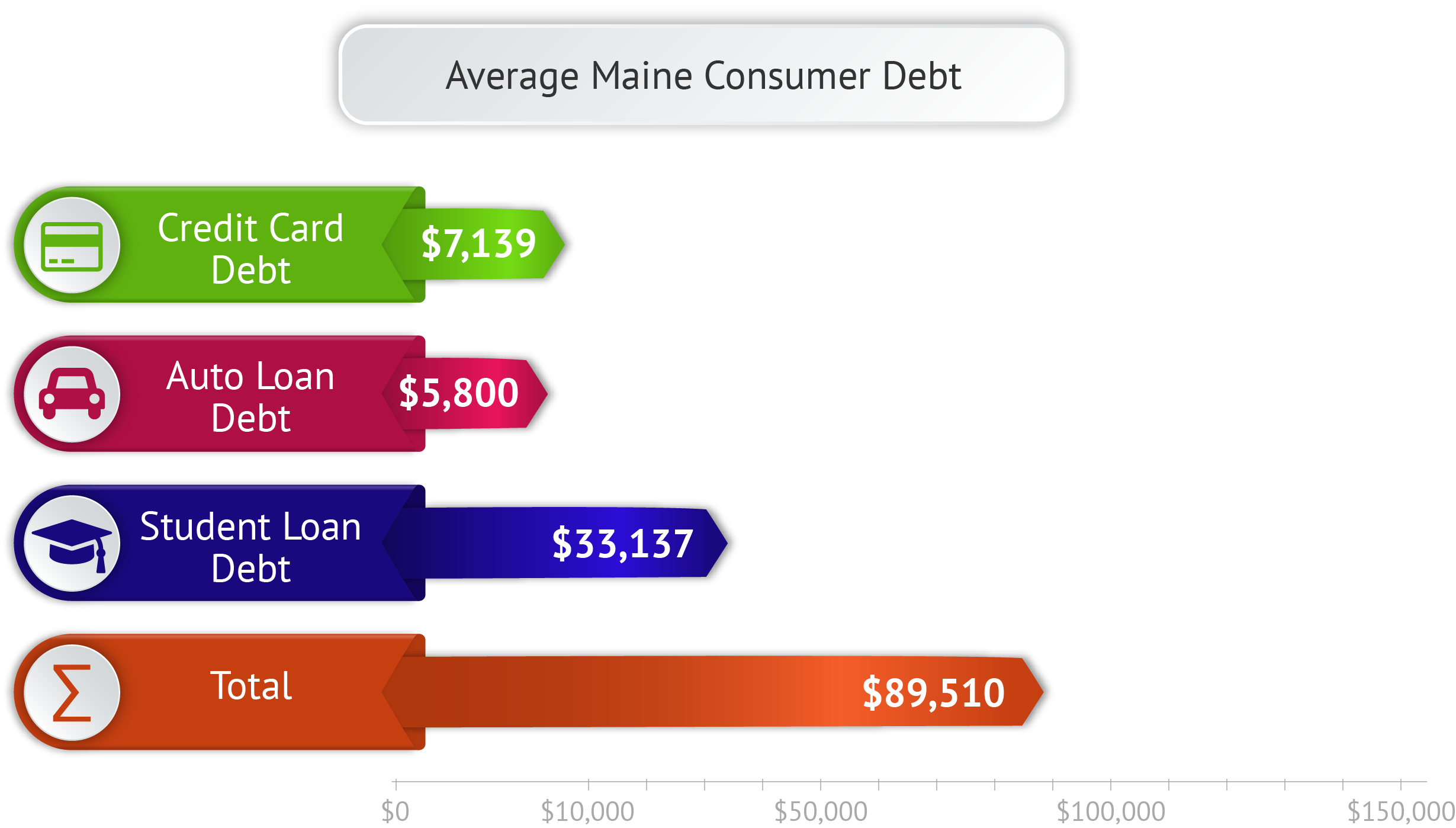
Debt remains a significant problem among Americans, with total consumer debt in the country exceeding $18 trillion as of 2025. According to Experian, in 2025 Mainers carried an average of $89,510 in total household debt balances. Although this figure is well below the national average of $104,755, it still characterizes a substantial issue that underscores the need for financial wellness education across the U.S.
Specific Statistics on Debt by Category
The World Population Review calculates the average student loan balance in Maine at $33,137 among those individuals who carry student debt. That adds up to a total of $6.2 billion owed on student loans in the Pine Tree State. Data from WalletHub indicate that the average Maine credit card debt per user is $7,139. And further statistics from World Population Review show that the average a Mainer owes on a vehicle loan is $5,800.
Maine Financial Literacy Legislation and Education Statistics
To illustrate the public education situation in American states, the National Education Association (NEA) puts out a report that summarizes number of schools, educators, and enrollment figures at the state level. According to the most recent NEA report (2025), there were 205 operating school districts in Maine with enrollment of 172,622 total students in the 2023-24 school year. Given the total number of teachers in those schools – 14,863 – the estimated student-to-teacher ratio was 11.6 to 1 as of that academic year.
The most recent state policy related to school financial literacy instruction was enacted in 2012. The “Act to Promote the Financial Literacy of High School Students,” LD 184, mandated that the Maine Department of Education would “develop a course on personal finance for use in secondary schools as part of the instruction in mathematics” which would “include instruction in purchasing, using credit, budgeting, saving and investing, banking, simple contracts, state and federal income taxes, personal insurance policies and renting or purchasing a home.” This course was to be offered in all secondary schools starting in the 2012-2013 school year.
In 2024, LD 1284 was enacted by the Maine Senate. Proposed by State Senator Mattie Daughtry, this bill served to separate financial literacy from the social studies curriculum and establish completion of a standalone personal finance course as a high school graduation requirement. However, it is unclear whether the bill was ever signed into law.
The Maine Department of Education does maintain a page on its website that provides both state-based and web-based resources for financial literacy instruction.