Maine Financial Literacy Standards
The Nation’s Report Card on Financial Literacy is a report that comes out every other year, published by the American Public Education Foundation (APEF). This “report card” assigns a grade to each state in the U.S., DC, and Puerto Rico based on their school standards for financial education. In its most recent report – September 2025 – the APEF awarded Maine the grade of “B” for its personal finance education standards.
The noteworthy accomplishments Maine has made – sufficient to earn the “B” grade – include requiring that high school students meet four Personal Finance Performance Expectations to earn a diploma; having financial literacy standards in the social studies strand for grades K-12; and providing online financial education resources. However, the state does not mandate a standalone personal finance class for high school graduation. Complying with this criterion would earn Maine an “A.”
Legislation relevant to the Pine Tree State’s financial literacy standards include LD 184, enacted in 2012, which required the State Department of Education to “develop a course on personal finance for use in secondary schools as part of the instruction in mathematics” which would “include instruction in purchasing, using credit, budgeting, saving and investing, banking, simple contracts, state and federal income taxes, personal insurance policies and renting or purchasing a home.” This course was to be provided to all secondary schools beginning with the 2012-2013 school year.
In February 2024, Maine Senator Mattie Daughtry proposed LD 1284, a bill that would separate financial literacy from the social studies curriculum and require completion of a standalone personal finance course for high school graduation. Although the bill was adopted by the Maine Senate, whether it was subsequently enacted into law remains unclear.
ME Financial Education Standards by Grade Level
In Maine, local school districts may choose to award high school diplomas based on credit or on proficiency. With either option, instruction in “civics and personal finance” is mandated as part of the two years of social studies and history required for high school graduation. Also at the high school level, Maine’s Social Studies standards list four Personal Finance Performance Expectations for earning a diploma.
Covering the earlier grade levels, at least one Personal Finance Performance Expectation is included in the Maine Social Studies standards for each grade from K-5, Early Adolescence (6-8), and Adolescence (9-Diploma). In addition, the Maine Department of Education website provides a Financial Literacy webpage with both Maine-based resources and online resources supporting instruction in financial literacy.

Recommended Policy for ME Financial Literacy Programs
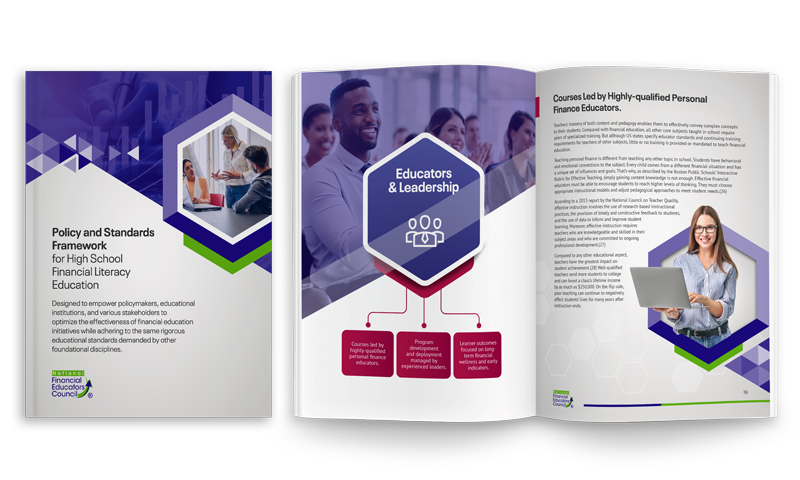
To address the gap in standards for personal finance education, the National Financial Educators Council has developed a set of benchmarks for all grade levels, K-12. This policy guide offers legislators a framework that standardizes educational quality and learner outcomes to provide the best possible financial education for American youth.
The Standards Guide is based on the notion that financial education should be treated with the same rigor as any other topic taught in schools and that all students should be capable – at minimum – of making near-term financial decisions.
National Standards for Financial Education
Financial Literacy Standards for Older Youth & Adults (High School through Adults)
Although there is no direct mandate by the Maine State Board of Education, it is recommended that national standards be implemented. Financial education is a unique subject; all participants have developed financial habits and relationships with money before instruction begins.
National standards are those that have been proven in empirical and theoretical research to produce the highest improvements in participant test scores.

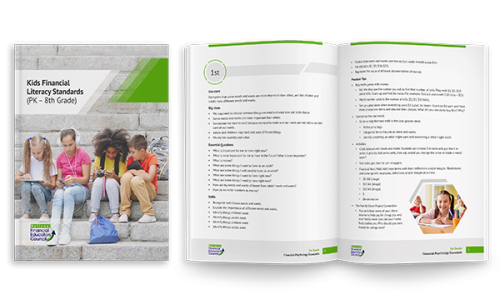
Financial Literacy Standards for Kids (Kids PK through 8th Grade)
In collaboration with education leader Heidi Jacobs, the NFEC created these financial literacy standards to define learning goals and educational targets for optimal child financial education. Guided by strong pedagogical theory, the standards ensure that instructional targets are age- and developmentally-appropriate and that lessons can be effectively scaffolded. Standards represent five sections based on topic areas in the NFEC curriculum.

Standards for Financial Education Instructors
The NFEC teamed with the well-known Danielson Group to develop the first and only national standards for financial educators – The Framework for Teaching Personal Finance – to define optimal educator skill sets and performance levels. The framework also identifies the financial educator responsibilities empirically proven to produce highest gains in participant test scores. This framework is used in all 50 states, including Maine.